Friday, January 26, 2007

Coral Reefs

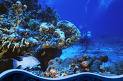
Coral reefs are beautiful structures that grow on the oceans bottom. They are sometimes refered to as sea gardens. The are composed of coral skeletons that build up on other coral skeletons. Corals are tiny sea organisms that live in colonies of several individuals. Coral reefs usually grow in tropical seas in an area known as the photic zone, an area of water that receives a large amount of sunlight for photosynthesis to occur. This zone also has mild wave action that occurs (waves that are not strong enough to destroy the reef). There has to be some wave action occur to be able to stir up the water enough to circulate oxygen and food around. There are several different forms a reef can take on. An apron reef is one that is short and slopes down from a peninsular shore. A fringing reef is directly attached to a shore. A barrier reef is one that is seperated from the mainland by a deep lagoon. Reefs alos cover about 284,300 sq. Km'sof the worlds oceans and support a large amount of biodiversity. Corals live in a very nutrient poor enviroment, but a process of nutrient cycling between the reef, zooxanthellae and and other organisms associated with the reef provide the right environment to be so rich in biodiversity.
Although reefs are such a beautiful environment, rich in biodiversity, they are being threatened, with activity being human activity being the primary threat. Humans continue to over-fish and pollute the worlds oceans, which causes a serious threat to the oceans ecosystems. But one thing that humans are doing to help save these ecosystems is putting them as marine protected areas.

Read More~>
~ http://en.wikipedia.org/wiki/Coral_reef

Thursday, January 25, 2007

The Dead Zone

Who knew too much of a good thing could really be bad! Well that's whats going on in the northern Gulf of Mexico. Too much nitrogen and phosphorus are entering into the gulf from the mississippi. The levels of nitrogen have increases about seven times from what use to enter into the gulf. The elements are one of the primary factors that are responsible for the algae blooms.
The dead zone, which is a zone in the northern Gulf of Mexico, is an area of low oxygen levels. This condition is known as hypoxia. When oxygen levels fall below 2 mg/L, then it is too low to be able to sustain life. Mobil fish are able to leave the area an survive, but bottom dwellers and plants are not able to leave and therefor die. This, along with the algae blooms, is making it difficult for the northern gulf to sustain marine life.

Read More~>
~http://www.tulane.edu/~bfleury/envirobio/enviroweb/DeadZone.htm

Wednesday, January 24, 2007

Industrial Fishing

A marine biologist from DalHousie university says that by the year 2050, that in order to avoid a global marine apocalypse such industrial fishing methods like bottom trawling and zoning ocean regions for specific uses need to be scaled back. Industrialized fishing methods, like trawling, are one of the driving forces that are leading to the depletion of the worlds marine biodiversity. A DalHousie university professor, Boris Worm, co-authored a book that predicted a collapse in the wolrds fish and seafood species within the first half of this century. The university professor spoke to the provincial government commitee on resource management and said that there is still a window of oppurtunity to prevent such a disaster, but this window is getting smaller and smaller every time a species from the marine environment disappears. "Once it's gone, it's gone...". There is no way to bring a species back once there gone, the only thing to do is leave it be and let recover on its own. The professors report stated that there has been a huge decline in the number of catches since fishing methods such as long-line and deep-sea dragging fishing methods have become world-wide in the 1950's. Along with pollution, destruction of habitat and climate change, is destroying the marine life. The professor thinks that people should go back to the old techniques of using a fishing hook and line, which also results in a better product and zero by-catches. This technique is being used in some parts of the world, like Iceland, where a boat operated by a single fisherman goes out. Mr. Worm does not think all bottom trawling is bad. He thinks it is okay in places liek the North Sea, which have sandy surfaces, and should only be done in places like that. He thinks that places that are used as spawning grounds should be protected from fishing.

I think people, along with government agencies, should start listening to what people like Mr. Worm has to say about the worlds oceans before it is too late. If people do not start doing something about it today, then there will be nothing left. The worlds oceans provide a lot of resources and to be able to have those resources replenished, then people need to stop things like over-fishing and bottom trawling. They should also stop thinking so much about money and more about the marine habitat. But these days, that is all a lot of people really care about, money. they do not care about what they do to get it or what ahppens as an end result. When there is nothing left in our oceans, that is when people will stop and think.


Read More~>

Friday, January 19, 2007

The Gulf of Mexico: The Dead Zone and The Red Tides

A red tide is another name for the phenomena of the algal bloom. A red tide occurs when there is an accumulation of marine algae in the water. These algae are also known as phytoplankton, which is a single-celled, plant like organism. These phytoplankton can form dense patches on the waters surface. When there are high enough concentrations of algae in the water, the water becomes discolored. Not all algae patches are dense enough to discolor the water. The red tides are not associated with tidal movements, which is why the term 'algae bloom' is used.
Starting in 1970, a region on the Gulf of Mexico, which is located in the northern part of the gulf, was recorded as being a 'dead zone'. This occured every 2-3 years due to increased levels of hypoxia. Now the dead zone is an annual thing in the gulf. Each year around spring time, ending around late August or September, the dead zone occurs. It is called the dead zone because oxygen levels are too low to be able to sustain the marine life there.


Phytoplankton, which cause red tides, share a relationship with hypoxia. The presence of nitrogen and phosphorus, along with a disrupted food chain, create favorable conditions for the toxic phytoplankton. Along with the low oxygen levels from the hypoxia, the red tides paralyze the respiratory supply in the water, which kills of more of the marine species.


read more~>


Thursday, January 18, 2007

The Bay of Fundy: A Tourism Potential

The Bay of Fundy is located on the Atlantic coast of North America. A study is being conducted to see if places along the Bay of Fundy can be a big tourist hotspot like the Cabot Trail or Peggy's Cove. The Bay of Fundy has some of the world's highest tides and a wide variety of tourist products can become available to take this location to the next level. A $10,000 study that is planned to be done by the end of February is being conducted on the Fundy shore area. The study hopes to show the area's current and proposed tourism developments and attractions. It will also analyze things like transportation links, accessability and accomadation capacity, which are all essential elements for any star tourist spot. The study will show researchers where holes in products and experiences and allow them to see what they need to do about it. Nova Scotia Tourism Visions say that three new star generator areas may attract somewheres between 600,00 - 750,000 visitors to the province a year. They belive that the Bay of Fundy has more potential has a tourist destination attraction. Some projects that are being planned include a new interpretive centre at the Joggins fossil cliffs and proposals for a Digby Area Fundy Discovery Centre, a Fundy Geological Museum expansion and a Cape Split trail system. Before any new tourist destinations are finalized, the roads need to be looked at to ensure that they provide a safe and comfortable access to the destinations, but can also enhance the expericence by offering things like amazing look-offs. Not only will the study help with the new planned tourist attractions, but it will show other oppurtunities that the Fundy has to offer in the future.

I personally think it is a great idea to show the rest of the world what Nova Scotia has to offer in tourism. The Bay of Fundy is a beautiful spot and it would be great if they did put tourist attractions there for more people to enjoy.


Read more~>

~http://www.herald.ns.ca/Business/553399.html

Wednesday, January 17, 2007

Gulf of Mexico

The Gulf of Mexico is located just south of the United States (west of Florida) and to the east of Mexico. It connects to the Atlantic Ocean
by the Straits of Florida. It is the ninth largest body of water on Earth and has three major rivers running into it, the Mississippi River, Brazos River and the Rio Grande. The Gulf of Mexico has been a good source of oil and gas. It was first discovered shortly after Christopher Columbus' first trip to the Americas by the Europeans. Overall, it covers and area of 579,000 ft.
read more~>

Friday, January 12, 2007

Global Warming

What is global warming? Is it just a bit of extra carbon dioxide in the atmosphere or is it the glaciers in the north melting a bit? No global warming is much more than that. Global warming is, in some eyes, a scientific fact. It more greenhouse gases being trapped in the atmosphere which is causing higher then normal averages both on land and in our oceans. Not only does it effect our planet, but it effects the well ebing of both humans and other living plants and animals on the earth as well. The sad reality is that the increase of greenhouse gases is warming up our atmosphere, which in turn increases earth temperatures, which will melt the glaciers faster then normal which will mean no habitat for species like the polar bears. And this is just one small chain of effects that global warming has on the planet. It has more effects on more issuse that people should be concerned about.


It's kind of funny, because last year some of my professors showed a video on global warming. Some scientists believed in global warming, some did not but people operating big businesses said that global warming was a positve thing. They said it was good to have warmer temperatures because people liked it more and that the trees were able to keep up with the incresing amount of carbon dioxide in the atmosphere becasue it increased their growth. i for one, believe in global warming and think it is an issuse that should be dealt with sooner rather than later not just to benefit us but to benefit our children and granchildren, so they can enjoy the beauty that the earth has to offer.

read more...